
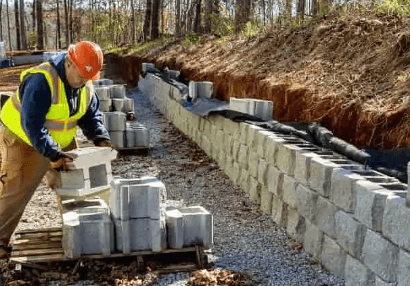
Concrete Retaining Walls
Poured and block retaining walls engineered to hold back sloped, clay-heavy terrain.
Retaining walls fail almost exclusively because of water — hydrostatic pressure building up behind a wall with inadequate drainage. We build in proper backfill, drainage gravel, and weep holes or drain tile on every wall regardless of size.
We build both poured concrete and segmental block walls depending on height, load, and budget, and we'll tell you when a wall needs engineering versus when it doesn't.
What You Get
Drainage built in
Gravel backfill and drain tile or weep holes on every wall.
Engineered for taller walls
Walls over code-threshold height are engineered and, where required, permitted.
Poured or segmental block
Right wall type for the height, load, and look you want.
Built for clay soil pressure
Backfill and compaction account for expansive clay behind the wall.
Our Process
- 1
Site assessment
We evaluate slope, soil, and drainage before recommending a wall type.
- 2
Excavation & footing
Footing excavated and poured to the load requirements.
- 3
Wall construction
Wall built up in lifts (poured) or courses (block).
- 4
Drainage & backfill
Drainage gravel, drain tile, and proper backfill compaction.
Retaining Walls Near You
Frequently Asked Questions
Do retaining walls need drainage?
Yes — nearly all retaining wall failures trace back to inadequate drainage. We install drainage gravel and drain tile or weep holes on every wall we build.
How tall can a retaining wall be without an engineer?
This varies by local code, but many jurisdictions require engineering above 3-4 feet of exposed height. We'll confirm the requirement for your specific site.
Poured concrete or block retaining wall — which is better?
Poured walls are stronger for a given thickness and suit taller or heavily loaded walls; segmental block is faster to install and often more budget-friendly for shorter walls.
Ready to Start Your Concrete Project?
Get a straightforward quote from a local Middle Tennessee concrete crew.